Recipes are among the longest-serving pieces of content a publisher owns. A good soup, a simple pasta dish or a family cake can keep attracting readers for years.
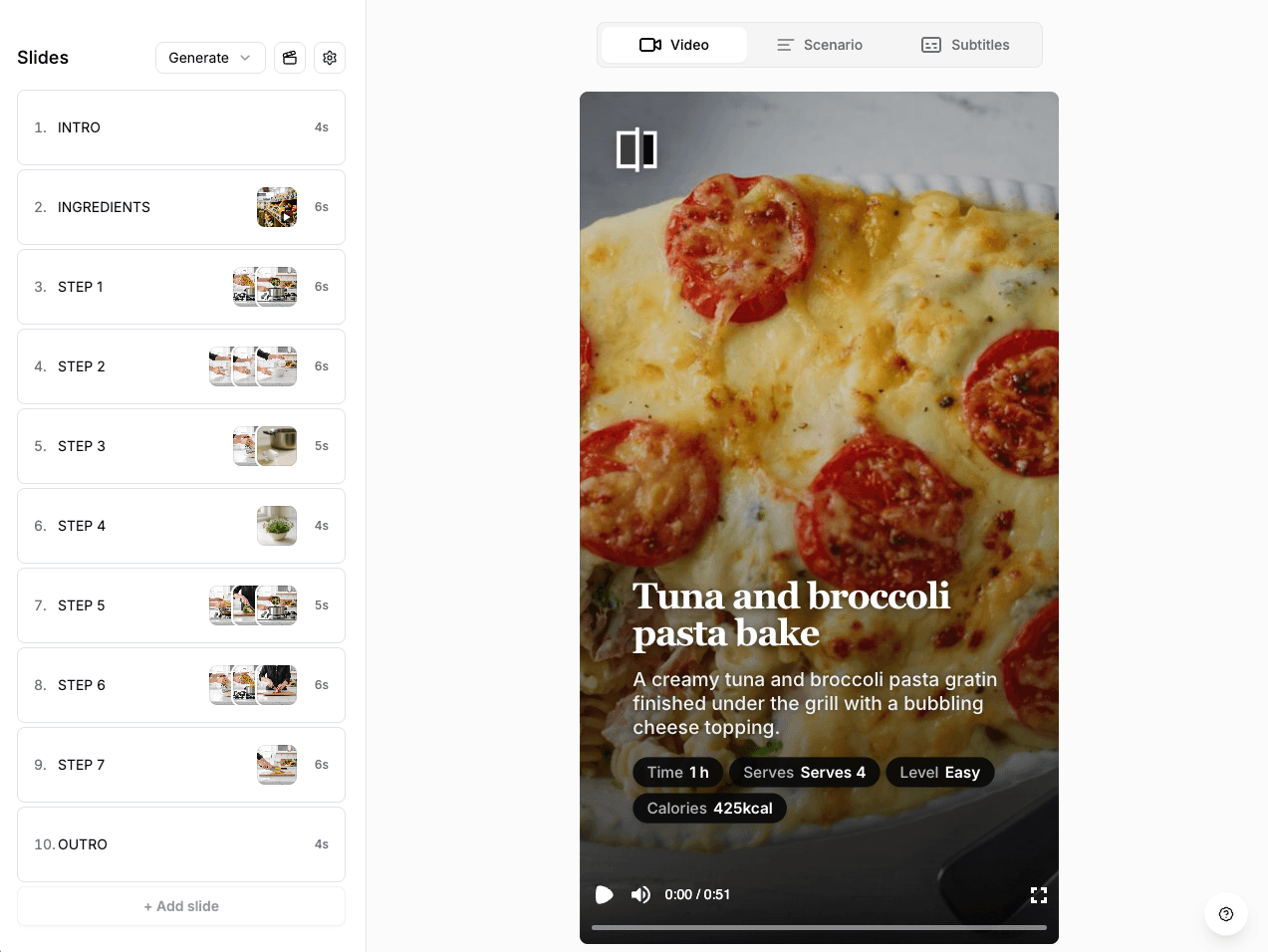
Our new Recipe video type helps publishers bring that content to new audiences as short videos. It combines ingredients, cooking instructions and recipe details in a format designed for social media and for people who want to cook the dish themselves.
Getting that balance right took some work.
Short enough to watch. Detailed enough to cook.
Recipes have their own structure. Alongside the instructions, there are ingredient quantities and details such as preparation time, servings or difficulty. Some recipes have three steps. Others have a long ingredient list and a much more involved process.
Condensing all of this into a video lasting a few dozen seconds means making careful decisions about what appears on screen, when it appears and how much time viewers need to read it.
The video needs to move quickly enough to hold attention, while giving someone watching on their phone the information they need to make the dish.
We built a dedicated slide structure for this. There is space for recipe details, layouts that accommodate longer ingredient lists, and a sequence of steps that guides viewers through the preparation. The recipe’s structure shapes the video.
Built for archives containing thousands of recipes
In our conversations with publishers, the question of scale came up almost immediately.
Many culinary titles have archives containing thousands of recipes. These are evergreen stories with plenty of life left in them. Publishers wanted to know whether they could process hundreds or thousands at a time.
Flipatic already has an API that supports automated processing. But making that workflow useful for recipes meant solving another problem: choosing suitable visuals without someone having to search for and select every image.
A script about chopping onions needs an image that makes sense at that moment. Across thousands of videos, those choices also need to feel visually consistent.
A unique image library for each title
Each publishing title gets its own exclusive library of more than 500 images, with a visual style created specifically for that title.
We analysed thousands of recipes to identify common ingredients and cooking actions. These form the foundation of every library: onions, salt, chopping, stirring and hundreds of other subjects.
The subjects are shared, but the images are unique to each title. Each library has its own look and feel, with consistent settings, lighting and atmosphere. Its images are used only by that title, giving its recipe videos a recognisable visual identity.
When Flipatic builds a script, it matches images from the title’s library to the context of each part.
If the narration describes chopping an onion, the system can select an image of that action or an image of an onion. If a step calls for adding salt, it can show someone seasoning food in a pan or pot, or use an image of salt itself.
This makes it possible to produce recipe videos at scale while keeping a distinct, consistent visual style for each title.
Ready to use, with full editing control
The aim is to produce recipe videos that are ready to use with little or no manual editing.
For publishers working through a large archive, this means the workflow can run automatically through the API, without requiring someone to edit every video.
Full editing remains available. Editors can review the result, change the text, replace an image or adjust the video whenever they want to. Automation handles the production work, while the publisher keeps control of the final result.
Give your recipes another way to reach people
A recipe published years ago can still help someone decide what to cook tonight. Short video gives that recipe another way to be discovered, watched and used.
With the new Recipe video type, culinary publishers can work with individual recipes or process whole collections, using a consistent visual style across their output.
If you publish recipes and would like to see how this could work with your archive, get in touch. We would be happy to test it with your content.